Haitao Chen
About Research Publications Teaching CV
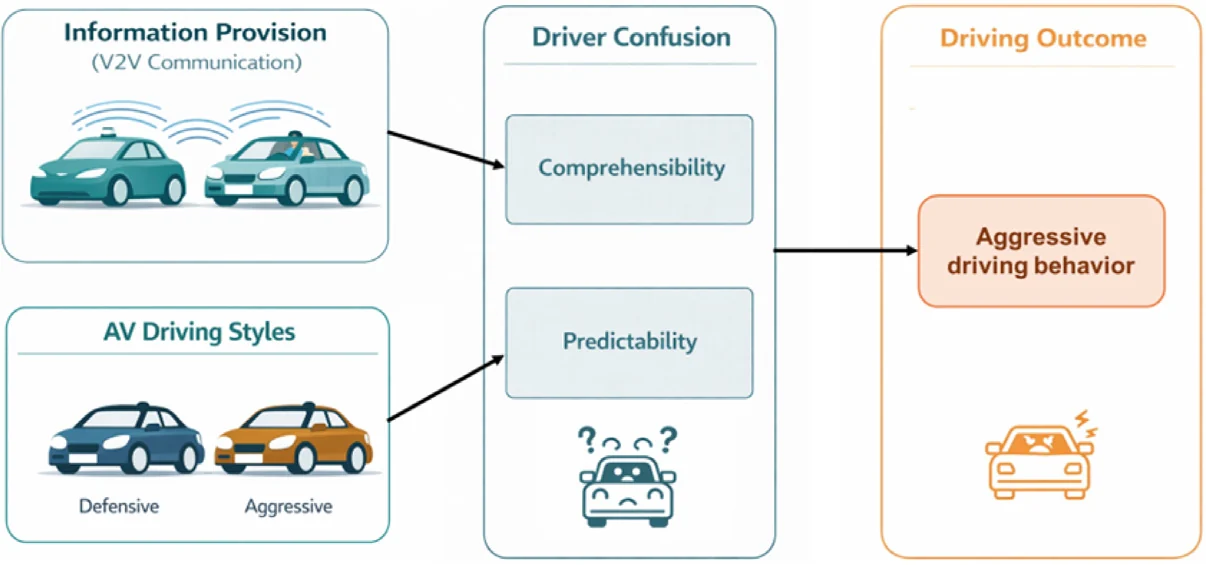
Two pathways for reducing driver confusion through V2V communication and AV driving style

Mitigating driver confusion and aggression in mixed traffic: Effects of V2V communication and driving style

Haitao (Book) Chen, Yiqi Zhang

Accident Analysis & Prevention, 2026

Paper/
Abstract

Drivers in human-driven vehicles (HDVs) can get confused when encountering automated vehicles (AVs) driving so defensively that their behavior differs from what human drivers actually expect. The confusion may potentially provoke aggression toward AVs and jeopardize traffic safety. This study investigated whether a vehicle-to-vehicle (V2V) communication system can help mitigate HDV drivers’ confusion and aggressive driving behavior toward AVs in HDV-AV interaction, considering the driving styles of both HDV drivers and AVs. Forty-eight participants, classified by driving style (defensive, moderate, or aggressive), completed a driving simulator experiment in two blocks (V2V-off vs. V2V-on). In each block, they interacted with aggressive AVs and defensive AVs, respectively. Behavioral indicators of confusion and aggressive driving behavior were recorded from the driving simulator, and subjective confusion was measured via questionnaires. The results showed that compared to the V2V-off condition, interaction under the V2V-on condition significantly reduced HDV drivers’ confusion and mitigated aggressive driving behavior during the interaction. Aggressive AVs that asserted their right-of-way elicited less confusion among HDV drivers than defensive AVs that were more inclined to yield to other vehicles. These findings suggest that V2V communication and aggressive yet rule-compliant AV driving styles help reduce driver confusion and aggressive driving behavior, thereby improving HDV drivers’ experiences and reducing conflict risk during HDV-AV negotiations.

Key finding: V2V cues improved decision alignment and reduced confusion and braking; and more assertive, yet rule-compliant AV behavior helped drivers interpret AV intent.

STISIM · V2V interface · Experimental design · Mixed-effects models
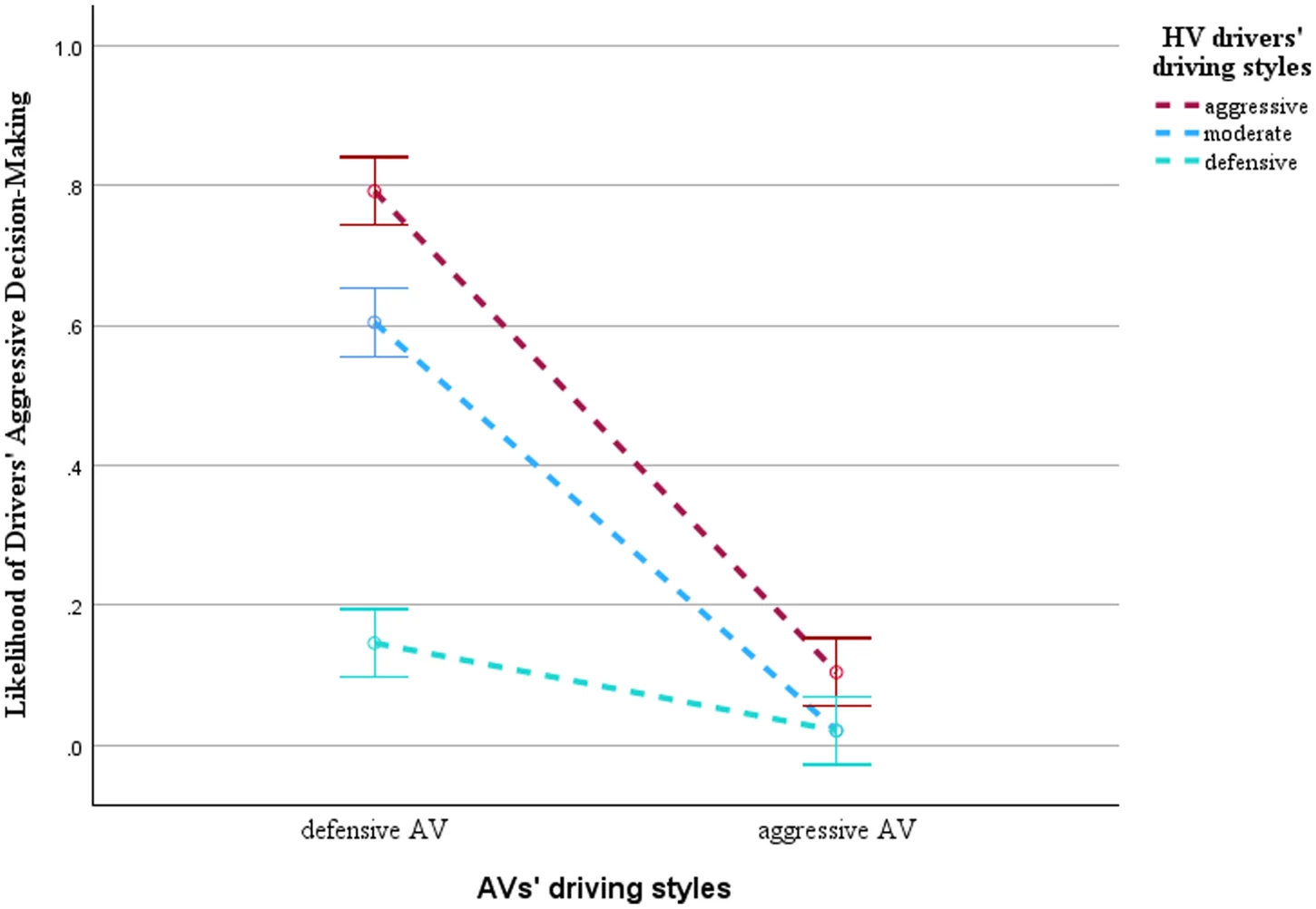
Decision-making chart comparing responses to defensive and assertive AV driving styles

Mitigating aggression toward AVs in mixed traffic: Effects of automated driving styles and human driving styles

Haitao (Book) Chen, Yiqi Zhang

Transportation Research Part F: Traffic Psychology and Behaviour, 2026

Paper/
Abstract

As automated vehicles (AVs) technology advances, the deployment of AVs creates a mixed traffic environment in which human-driven vehicles (HVs) and AVs interact and coexist on the roads. This study investigated the effects of AVs’ automated driving styles on HV drivers’ decision-making, driving performance, and subjective evaluation while considering the manual driving styles of HV drivers. Thirty-six drivers participated in a driving simulator experiment, interacting with aggressive and defensive AVs in two separate blocks and experiencing four driving scenarios in each block. The results indicated that drivers with more aggressive driving styles tend to make less aggressive decisions when interacting with aggressive AVs compared to defensive AVs. In contrast, the decision-making of drivers with more defensive driving styles was not significantly influenced by AVs’ driving styles with which they interacted in mixed traffic. Regarding driving performance, all drivers demonstrated less aggressive behaviors when interacting with aggressive AVs than with defensive AVs, as reflected in longer time-to-collision (TTC). Additionally, human drivers reported lower trust and perceived higher risk when interacting with defensive AVs compared to aggressive AVs, with this effect varying based on their driving styles. These insights are crucial in informing the development of AV algorithms and establishing robust traffic regulations to enhance safe interactions between human drivers and AVs in mixed-traffic environments.

Key finding: More aggressive AV behavior helped mitigate aggressive human-driver decisions and led to larger safety margins.

STISIM · Driving simulation · Driver behavior · Logistic mixed models

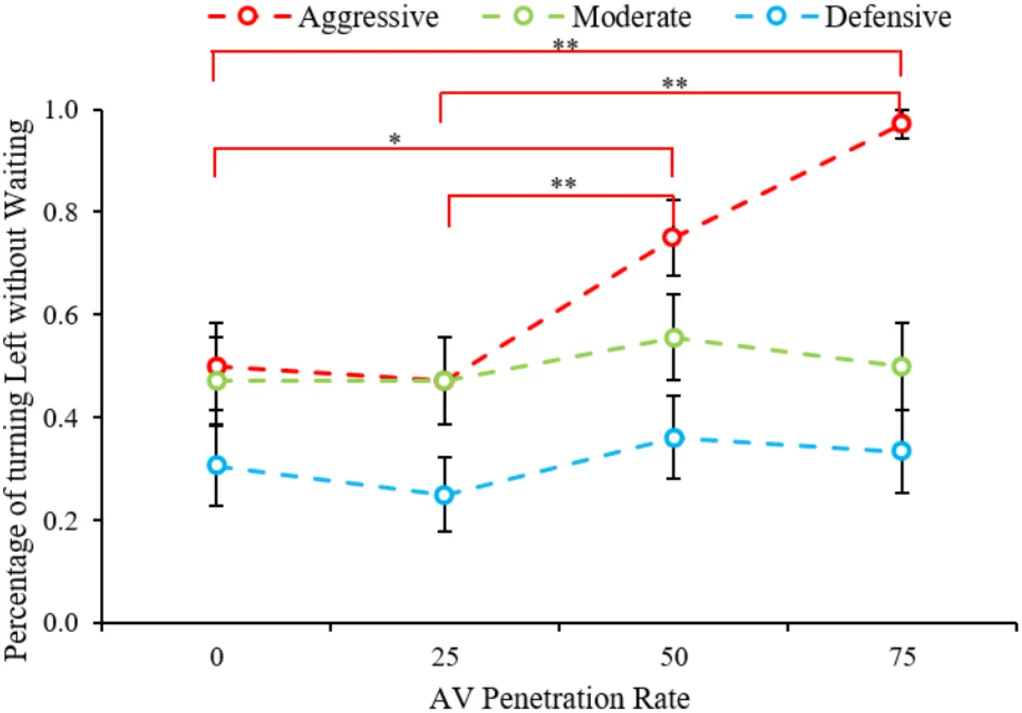
Graph of human driver decisions at different AV penetration rates

Behavioral adaptation in mixed traffic: the roles of AV penetration rate and human driving style

Haitao (Book) Chen, Zheng Ma, Yiqi Zhang

Accident Analysis & Prevention, 2026

Paper/
Abstract

Automated vehicles (AVs) are designed to improve traffic safety, mobility, and driver comfort; however, their benefits depend on the widespread adoption of AVs. As full market penetration remains unlikely in the near term, AVs will continue to operate alongside human-driven vehicles (HDVs), making it essential to understand their interactions and the implications for traffic safety. This study investigated how different AV penetration rates (0%, 25%, 50%, 75%) influence HDV drivers’ behavioral adaptation at the tactical level and subjective evaluations, while considering drivers’ individual driving styles (aggressive, moderate, and defensive). Thirty-six drivers participated in a driving simulator experiment involving two driving scenarios (left-turn and lane-change scenarios) under varying AV penetration rates. Drivers’ adaptive decision-making in response to AVs’ defensive driving, as the AV penetration rate changed, was measured by the frequency of left turns executed without yielding and the distance maintained from surrounding vehicles during lane changes. Subjective evaluations were assessed through perceived safety and anxiety ratings collected after each trial. Results indicated that the influence of AV penetration rate was moderated by driving style. In the lane-change scenario, increased AV penetration rate resulted in more adaptive decision-making among aggressive and moderate drivers, whereas in the left-turn scenario, this effect emerged only for aggressive drivers. In contrast, AV penetration had no significant effect on defensive drivers’ behavior in either scenario. These findings suggest that higher AV penetration may compromise safety in mixed traffic by provoking more aggressive decision-making and aggressive behavior among certain driver types, highlighting the need to account for driver adaptation patterns in AV deployment strategies.

Key finding: Aggressive drivers adapted more aggressive negotiation decisions as AV penetration increased; defensive drivers exhibited relatively stable behavior across penetration rates.

STISIM · AV penetration · Behavioral adaptation · Mixed-effects models

© 2026 Book (Haitao) Chen hbc5417@psu.edu · GitHub